Most luxury homes in Greece are still built from reinforced concrete — the same way homes have been built here since the 1960s. Concrete works. But it was never optimised for the Mediterranean climate, for seismic zones, or for buyers who expect to build in months rather than years. Cross-Laminated Timber (CLT) changes all three equations. CLT homes Greece represents the most significant shift in how luxury properties are built and delivered in this market. This is not an aesthetic preference. It is an engineering argument — and it is worth understanding before you invest in sustainable homes Greece has to offer.
The Greek Climate Problem That Concrete Cannot Solve
Greece receives more than 3,000 hours of sun per year. In the Peloponnese, peak summer temperatures regularly exceed 37°C. For a concrete structure, that is a problem embedded in the physics of the material itself.
Concrete has a thermal conductivity of approximately 1.4 W/m·K — it absorbs heat rapidly during the day and radiates it back into the interior through the evening and night, precisely when you want to sleep. The result is a home that requires intensive air conditioning to remain liveable through a Greek summer.
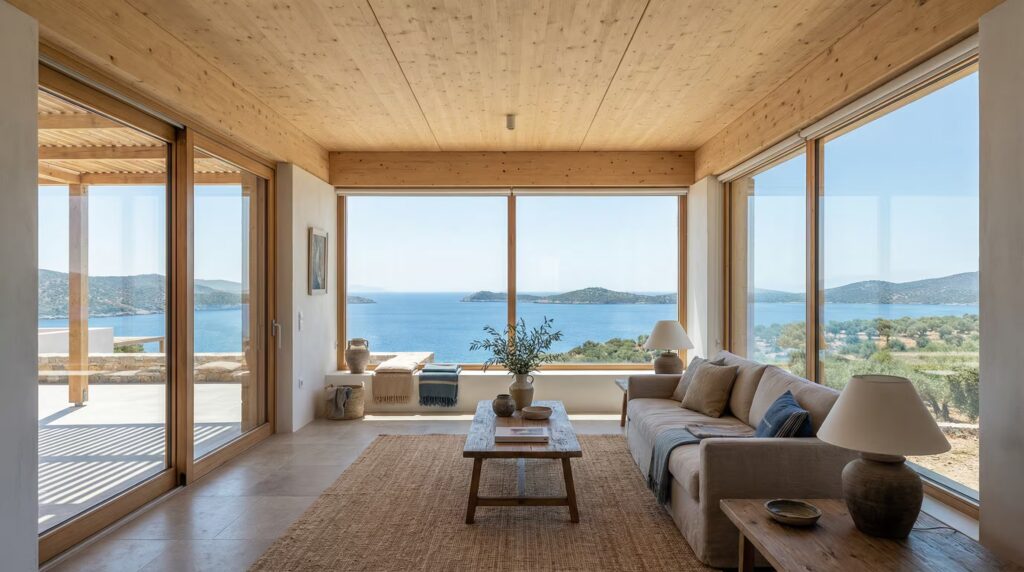
CLT has a thermal conductivity of 0.13 W/m·K — approximately ten times better as an insulator. But the more important figure for a hot Mediterranean climate is the decrement delay: the time lag between outdoor heat peaking and that heat reaching the interior. With CLT construction, that lag is 10 to 14 hours. Heat peaking outside at noon arrives at the interior surface around midnight — when windows can be opened and the structure ventilated naturally, without mechanical cooling.
This is passive cooling engineered into the structure itself. Every CLT home built by Luxury Development Greece targets an A+ energy performance class as standard, meeting Greece’s implementation of the EU Energy Performance of Buildings Directive (EPBD 2024/1275) ahead of the May 2026 deadline — and well ahead of the near-zero-emission requirement for new builds from 2030.
For anyone researching energy efficient homes in Greece, the thermal physics alone justify a closer look at CLT. Compared to a conventional concrete villa in the Peloponnese, a CLT home delivers meaningfully lower cooling loads, lower energy bills, and more stable interior temperatures year-round. CLT homes in Greece consistently outperform concrete on every thermal metric that matters in a Mediterranean summer. The combination of insulation value and decrement delay is what makes CLT homes in Greece genuinely energy efficient homes Greece buyers can rely on through a 40°C August.
Seismic Resilience — Where CLT Homes in Greece Outperform Concrete
Greece sits on one of Europe’s most seismically active zones. Seismic performance is not a secondary consideration in Greek construction — it is a primary engineering constraint, and CLT homes in Greece address it directly. Choosing CLT for sustainable homes in Greece means building to a standard that handles both climate and geology.
Concrete is heavy. Mass is a liability in seismic events: the greater the mass of a structure, the higher the inertial forces transmitted through its foundations during ground movement. CLT has a high strength-to-weight ratio — lighter structure, lower seismic loads, better performance on the same foundations.
The SOFIE project — a major European research programme — demonstrated that CLT buildings can achieve a q-factor of 3.0 under seismic loading for structures up to seven storeys. That result is accepted under Eurocode 8, the European standard governing structural design in high-seismicity zones. CLT seismic performance is not a marketing claim — it is a researched, tested, code-compliant outcome.
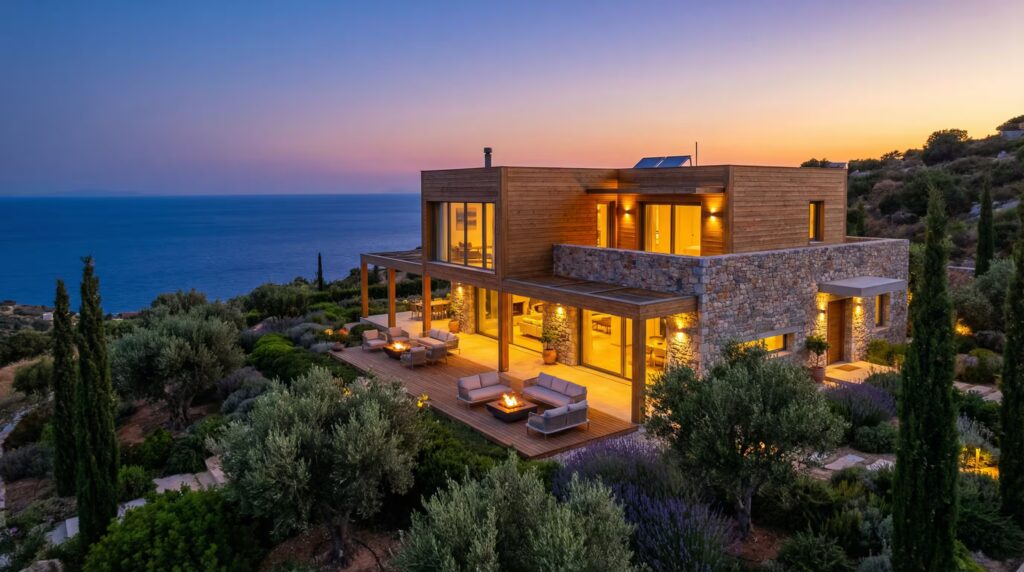
There is also a historical dimension worth noting. Traditional timber framing in the Ionian Islands was developed specifically as a seismic response: lightweight timber structures on stone bases designed to flex and absorb rather than resist and crack. CLT is the engineered evolution of that principle, applied with modern manufacturing precision and verified against international structural codes — which is precisely why CLT homes Greece now meet the same seismic compliance standards as reinforced concrete.
Carbon Footprint — The Environmental Case Is Clear
Concrete is one of the top industrial sources of CO₂ globally. The chemical reaction that converts limestone to cement releases CO₂ as an unavoidable byproduct — embedded carbon that accumulates before a single truckload reaches a construction site.
CLT operates on the opposite principle. Trees sequester CO₂ as they grow; when used as structural panels, that carbon remains locked in the building for its entire lifespan. CLT is, structurally, a carbon sink. A review of 27 studies cited by the MIT Climate Portal found that CLT construction can reduce the lifetime carbon emissions of buildings by approximately 40% compared to traditional materials.
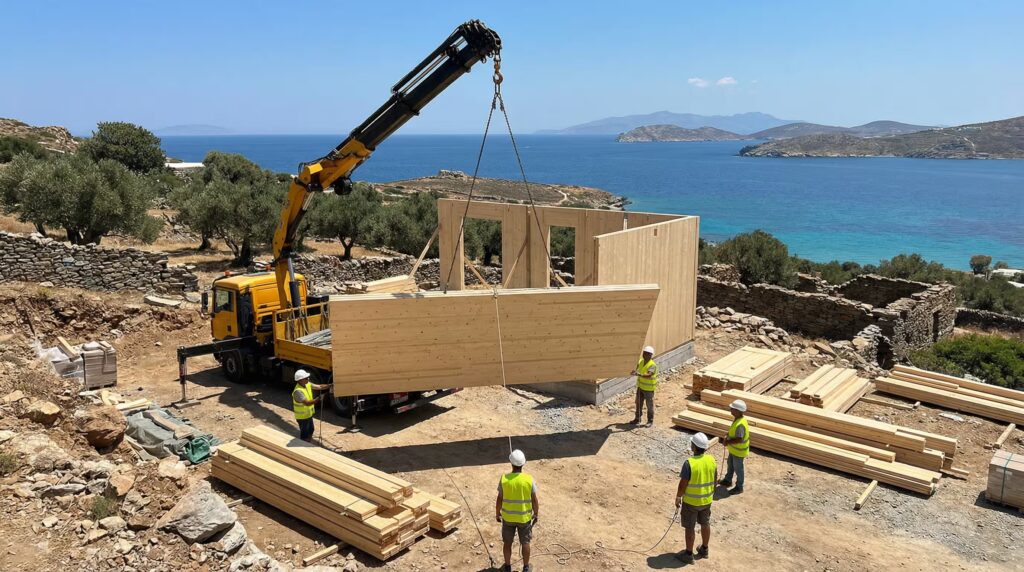
The construction process itself is cleaner. CLT panels are CNC-machined in the factory to tolerances of ±1mm, arriving on site cut, labelled, and ready to assemble. Construction waste is minimal — a significant contrast to concrete and masonry construction, which generates substantial debris and requires extensive on-site forming, curing, and cleanup.
For buyers prioritising eco-friendly construction Greece wide, this is not a symbolic difference. A 40% reduction in lifetime building carbon, combined with a cleaner build process, is material — both environmentally and operationally. It is also one of the most concrete reasons CLT homes in Greece qualify as genuinely sustainable homes Greece buyers can build with confidence.
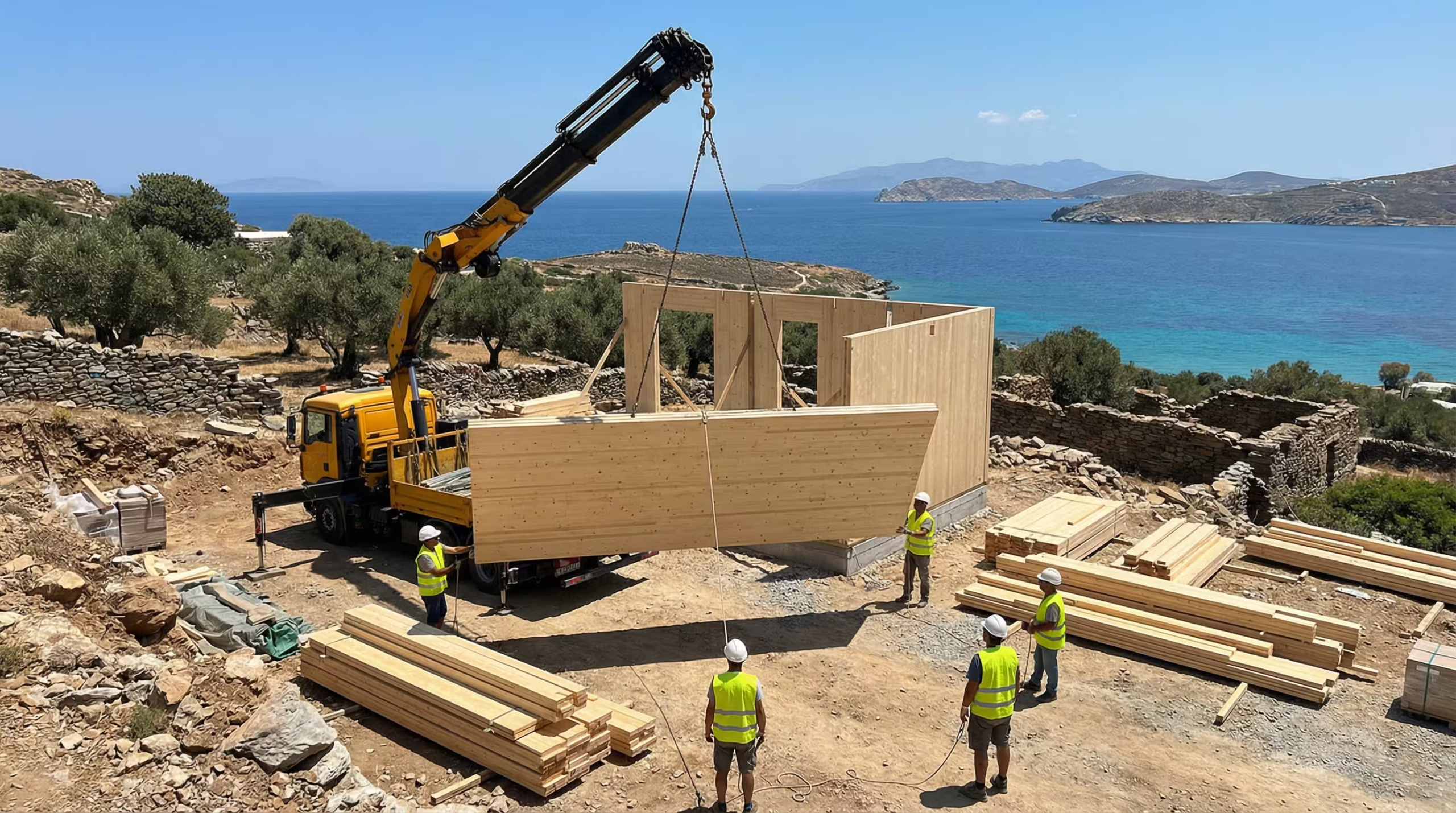
Traditional masonry and concrete construction in Greece typically takes 18 to 24 months for a villa. CLT construction is a different process: panels are CNC-manufactured in the factory, delivered pre-cut and pre-labelled, and assembled on site in sequence. The structural shell goes up in days; finishing follows on a structure that is already dry and dimensionally precise.
The total project timeline for a bespoke CLT home through Luxury Development Greece — from finalised design to handover — is approximately 6 months. For buyers, that compression has direct financial consequences:
- Lower carrying costs — interest and overhead measured in months, not years
- Faster rental or occupancy access — direct impact on returns
- Shorter construction risk exposure — a factory-controlled process is far less vulnerable to weather and site delays
- Golden Visa timelines — 6 months is materially different from 18 for buyers pursuing Greek residency through property investment
The Fire Question — Addressing the Obvious Concern
The intuition that wood burns is correct. The conclusion that CLT is therefore a structural fire risk is not.
When CLT panels are exposed to fire, they char at approximately 0.7mm per minute. The carbonised surface layer actively insulates the structural timber behind it, slowing penetration and preserving load-bearing capacity. REI 60 fire resistance is achievable as standard; with 16mm gypsum board added, that rises to REI 120. CLT panels are classified Euroclass D-s2, d0; flooring is Dfl-s1.
Concrete can crack and spall under extreme sustained heat, compromising structural integrity in ways that are less predictable than CLT’s controlled charring. CLT fire behaviour is measured, testable, and fully code-compliant.
Sustainable Homes in Greece — What Buyers Are Now Asking For
Bioclimatic design is now the defining trend in Greek luxury property. As Country & Town House reported in 2025, bioclimatic has become the buzzword in the Greek real estate market. Two of Greece’s most prominent developments — Costa Navarino in the Peloponnese and Elounda Hills in Crete — both cite bioclimatic design as central to their proposition. The expectation has moved from niche to standard at the top of the market.
The regulatory direction reinforces it. Greece’s EPBD implementation deadline is May 2026; near-zero-emission new builds are required from 2030. Energy performance is moving from preference to compliance.
The buyer profile is changing too. European and international buyers in the luxury segment — particularly from the UK, Germany, and the Netherlands — are increasingly specific about energy credentials, environmental performance, and long-term operational costs. They are building eco-friendly homes in Greece not because it is fashionable, but because it aligns with how they live and what they expect from a significant investment.
Building energy efficient homes in Greece in 2026 is no longer a niche position, and CLT homes in Greece are the clearest expression of that shift — the market, the regulation, and the engineering are all pointing in the same direction. The Peloponnese, with its climate, landscape, and concentration of international buyer interest, is where the demand for sustainable homes in Greece is most clearly defined. For buyers who have decided that sustainable homes Greece must deliver on both aesthetics and performance, CLT sets the standard.
Explore our CLT villa designs →
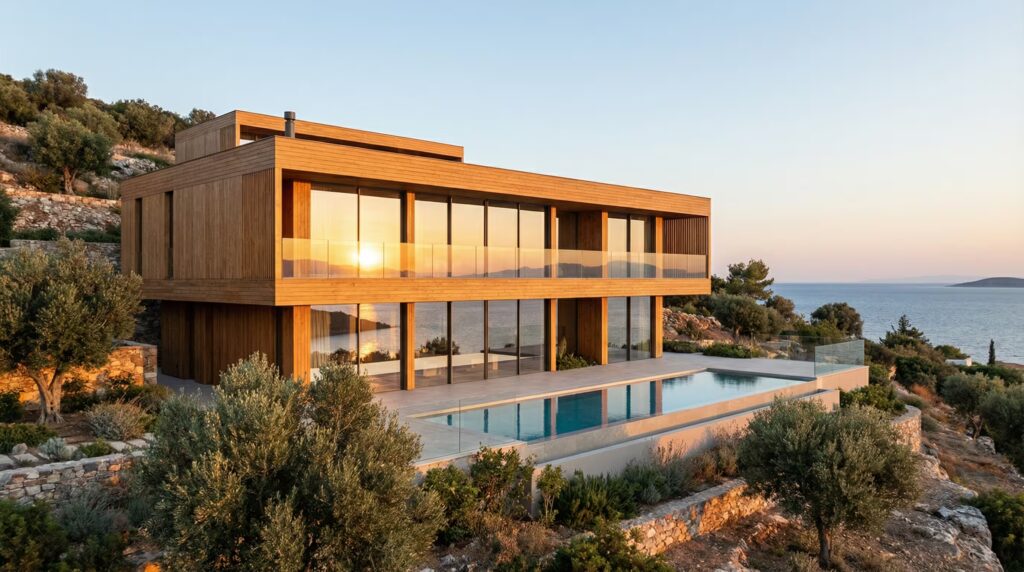
Concrete was the right answer for Greece in 1965. In 2026, the brief has changed: A+ energy ratings, near-zero carbon targets, seismic compliance, and a market that will not wait 18 months to build.
CLT meets every part of that brief — better thermal performance, lower seismic loads, 40% fewer lifetime carbon emissions, and a build timeline three times faster than conventional masonry. Energy efficient homes Greece buyers are building today are increasingly CLT homes in Greece, and the data explains why. For anyone planning sustainable homes in Greece — particularly eco-friendly villas in the Peloponnese or on the Greek islands — the engineering argument is not a close call.
Luxury Development Greece builds bespoke CLT homes Greece-wide, with a focus on Porto Heli and the wider Peloponnese — from plot to keys, with no compromises on performance or aesthetics.
View our sustainable villa designs →
Learn how our CLT process works →
Start the conversation →